Background
BWCA
Native American Caucus Condemns Senate Vote Overturning Boundary Waters Mining Ban
"Friends of the Boundary Waters says that the Minnesota DNR still has the power to cancel the mineral lease, and they are calling on people to contact the DNR and encourage them to do so."
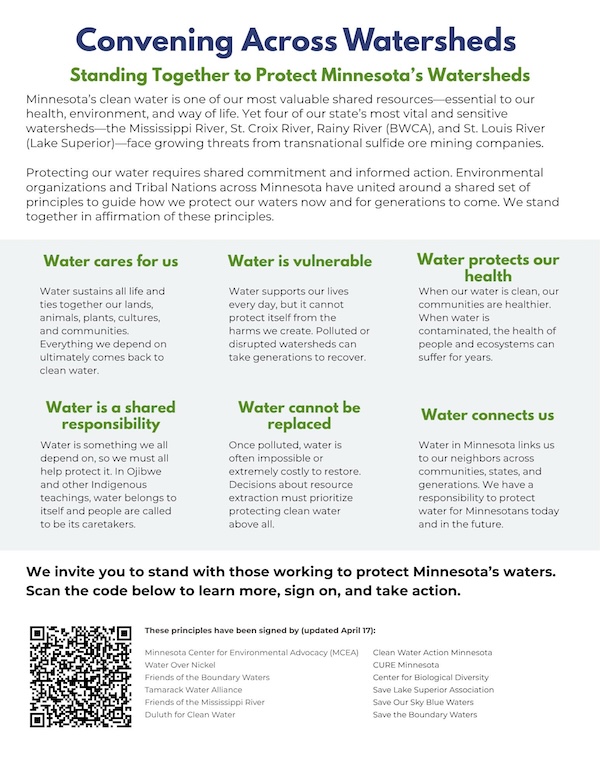
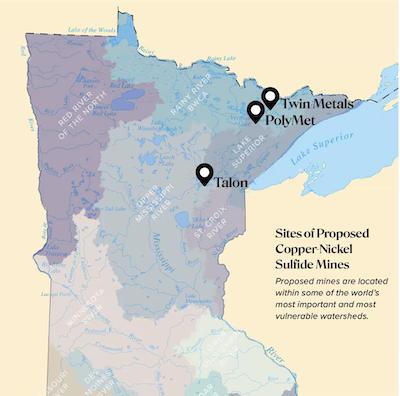
"Today, the US Senate revoked a 20-year mineral withdrawal protecting 225,378 acres of public lands in the Boundary Waters Canoe Area Wilderness watershed from toxic mining on 50-49 vote. The move was led by Minnesota Republican Pete Stauber and paves the way to permanent pollution from a proposed sulfide-ore copper-nickel mine that Chilean mining giant Antofagasta has long sought to develop directly upstream of the Boundary Waters through its subsidiary, Twin Metals."
"Today is a dark day for our people and homelands — this battle is far from over.
"For thousands of years, our ancestors navigated these interconnected lakes and rivers. Today, millions come to paddle, fish, hunt, hike, dogsled, and pray. This is one of the most visited wilderness areas in the country. And it belongs to the public — not to foreign mining corporations.
"The science is clear: this watershed is vast, pristine, and interconnected. Sulfide mining threatens both fish and humans with mercury, endangers manoomin and psin — the good berry — wild rice — and risks drinking water for generations. Furthermore, it threatens our economy and jobs, outdoor stewardship, public health, and will have wide-reaching impacts on cultural, spiritual, and subsistence practices for future generations to come. Pollution doesn't stay put-it flows, and it bioaccumulates. It is not a question of if it will pollute irreversibly; it is a question of when.
"Stand with clean water. Stand with workers. Stand with democracy. Stand with Sovereignty. Stand with Minnesotans. If we protect the water, it will protect us. We remain committed to doing everything in our collective power to protect the Boundary Waters, a sacred place, and we will never stop defending our natural relatives."
— Members of the Native American Caucus in the Minnesota Legislature: Senator Mary Kunesh (DFL-New Brighton), Representative Heather Keeler (DFL-Moorhead), Representative Liish Kozlowski (DFL-Duluth), and Representative Shelley Buck (DFL-Maplewood)
Other coverage
- Congress overturns ban on mining near the Boundary Waters
- Scores of Forest Service plans could be upended after Boundary Waters mining vote
- Buzzards Circling The Iron Range
- Minnesota Indigenous lawmaker: Boundary Waters vote an 'assault' on tribal sovereignty
- Senate votes to end ban on mining in Boundary Waters after Sen. Tina Smith's hourslong speech
- Save the Boundary Waters Action Center
- Friends of the the Boundary Waters on Sulfide Mining
- Water Legacy Action Center
- Sportsmen for the Boundary Waters coverage
"Imagine if we had a coalition that protected our northern waters / wild rice / Native communities with the same pride of place and love for our neighbors that we saw during the occupation?"
We can make that happen
PolyMet/NewRange
"The sulfide mine proposed by PolyMet/NewRange upstream of Lake Superior poses one of the biggest threats to freshwater in our state. If built, Polymet/NewRange would create centuries of water pollution to the Lake Superior watershed and place thousands of people who live in downstream communities at risk, including the Fond du Lac Band of Lake Superior Chippewa, Duluth, and Cloquet."
Wetlands
Minnesota Center for Environmental Advocacy (MCEA)
"Minnesota is known as the Land of 10,000 Lakes, but our wetlands may be our greatest environmental asset. They filter pollution from our water, buffer our communities from floods, combat climate change, and provide irreplaceable habitat for birds, fish, and wildlife that make Minnesota, Minnesota.
"Right now, these unsung natural heroes are under threat. Proposed federal rollbacks would gut wetland protections to their weakest level since the 1980s. But Minnesota has a chance to step up, strengthen our own protections, and set an example for the rest of the country. We sat down with wetland and stream ecologist Susan Colvin to talk about the hidden benefits of wetlands, what’s at stake in the proposed cuts, and what we can do about it."
Nitrate pollution and the public health crisis in SE Minnesota
Contaminated drinking water is linked to cancer, birth defects and pregnancy complications
"Over 500,000 Minnesotans are facing a drinking water crisis fueled largely by agricultural nitrate pollution from fertilizer and manure seeping into surface and groundwater sources.1 The nitrate pollution is largely driven by industrial agricultural practices, like Concentrated Animal Feeding Operations (CAFOs) and row crops."
Minnesota’s largest animal feedlot wants to double in size
What’s at stake for our water, climate, and communities
"Consolidation in the dairy industry has driven many of Minnesota’s small farms out of business, leaving in their place industrial-sized operations where cows and other livestock are confined in warehouse-like barns.
"The change hasn’t just affected small farm owners or the quality of life for the animals; it’s also had profound effects on our water and climate. Runoff from animal manure contaminates rivers, streams, lakes, and groundwater with nitrogen pollution, and methane emissions from these large facilities pose significantly greater risks to the changing climate than carbon dioxide. These industrial agricultural practices also degrade soil, reducing its ability to store carbon."
Data Centers and Water Consumption
Large data centers can consume up to 5 million gallons per day, equivalent to the water use of a town populated by 10,000 to 50,000 people
"According to scientists at the University of California, Riverside, each 100-word AI prompt is estimated to use roughly one bottle of water (or 519 milliliters). This may not sound like much, but billions of AI users worldwide enter prompts into systems like ChatGPT every minute. Large language models require many energy-intensive calculations, necessitating liquid cooling systems."